Blog post
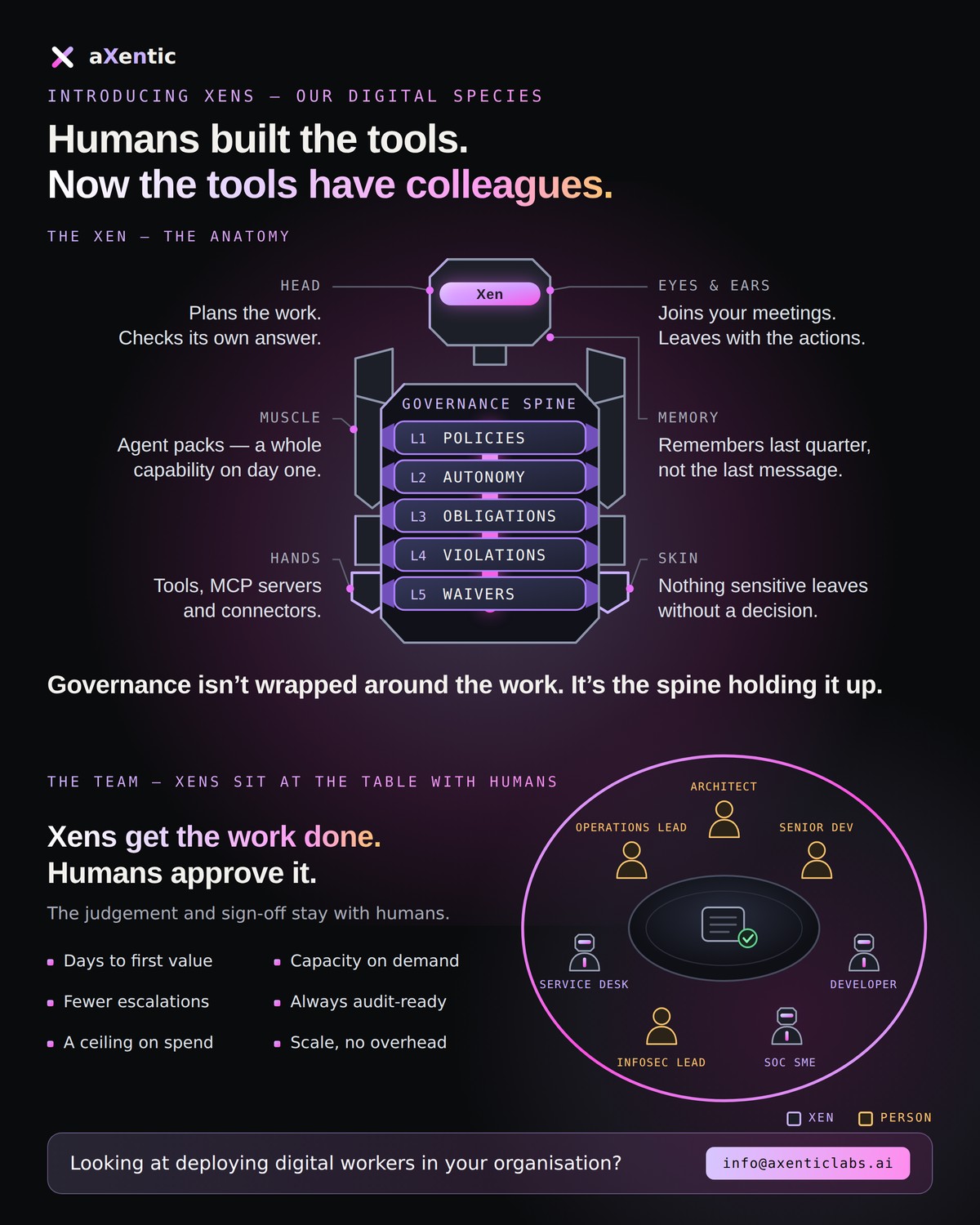
Humans built the tools. Now the tools have colleagues.
No one person sees the whole estate, and there is more in flight than anyone can hold in their head. So architecture reviews queue, access requests sit, and audit evidence gets reconstructed after the fact.
A design comes back from pen test with a finding everyone could have predicted. It was knowable months earlier, at design time. Nobody disagreed about it then — the people who would have raised it were in other rooms.
That is what scarcity looks like in a large enterprise. No one person sees the whole estate. There is more in flight than anyone can hold in their head, and some systems are older than the teams that run them — whoever built them has moved on, and what they knew sits in old tickets and a runbook nobody has opened in years.
So the work waits. Architecture reviews queue behind one person. Access requests sit. Audit evidence gets reconstructed after the fact. None of that is a talent problem. It is an availability problem.
So we built Xens. A Xen is a digital colleague, hired into a role. It carries what usually lives in people’s heads — the standards, the prior decisions, the domain playbooks — and what it learns, it keeps. SME-level knowledge that does not leave when people do.
It does not make the call. It does the work that comes before the call: pulls the context together, checks the design against the standards, assembles the evidence, flags what is missing. And it does that across every review in the queue at once, so your expert arrives to a decision rather than a research task.
The call itself stays human. So every Xen has a named owner, a ceiling on what it can do unsupervised, and a record of everything it did. And a spine — not a policy document sitting beside the work, but the structure the work hangs off. A Xen cannot act outside it, and cannot be configured to.
Xens get the work done. Humans approve it.
If you are looking at deploying digital workers in your organisation, we would like to hear about it.